
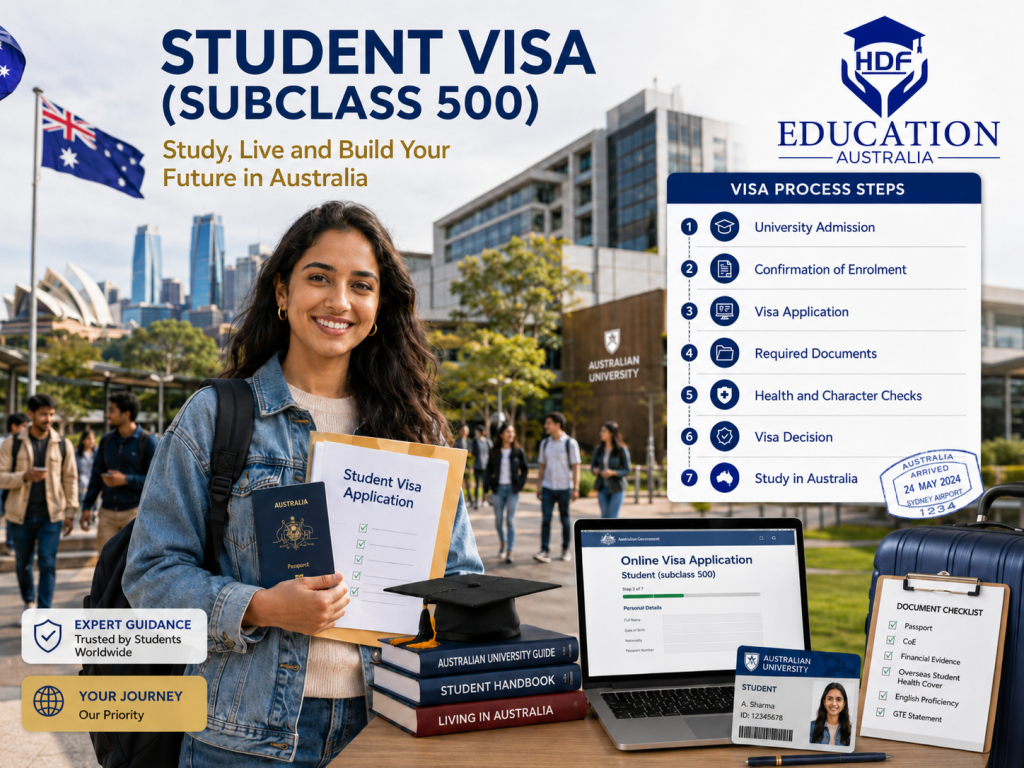
New visa fees, strict financial checks, updated Genuine Student (GS) requirements, and revised onshore application rules have reshaped how Student Visa applications are assessed. Advice that was accurate a year or two ago may now be incomplete, or worse, lead to avoidable mistakes.
Whether you’re applying for your first Australian Student Visa or planning to continue your studies, this guide explains the latest 2026 requirements for the Student Visa (Subclass 500), so you know exactly what to expect before you lodge your application.
Student Visa (Subclass 500) at a Glance | 2026
Requirement | 2026 Update |
Visa Application Fee | AUD $2,500 (concessional charge of AUD $2,050 continues for eligible Independent ELICOS and Non-Award students, and for eligible primary applicants holding passports from ASEAN member countries, Pacific Island nations, and Timor-Leste) |
Minimum Living Funds | AUD $29,710 for a single student |
Key Requirements | Confirmation of Enrolment (CoE), Genuine Student (GS), Overseas Student Health Cover (OSHC) |
Work Rights | Up to 48 hours per fortnight during study periods |
Processing System | Prioritised under Ministerial Direction 115 |
Visa Length | Up to 6 years, depending on your course and enrolment |
Source:
Student Visa (Subclass 500) – Australian Department of Home Affairs
Student Visa Application Charge Increase – Study Australia
What’s Changed for the Student Visa (Subclass 500) in 2026?
If you’ve read older student visa Australia guides, this is the section you shouldn’t skip.
Australia didn’t just tweak a few visa rules. It introduced a series of reforms aimed at strengthening the integrity of its international education system. The focus has shifted towards attracting genuine students who are financially prepared, academically committed and enrolling in courses that genuinely support their future careers.
Here’s what changed.
Australia Is Now One of the Most Expensive Study Destinations to Apply For
From 1 July 2026, the base application fee for a Student Visa (Subclass 500) increased to AUD $2,500, up from AUD $2,000.
That’s a 25% increase in just one year.
While eligible students in the ELICOS and Non-Award sectors can access a concessional application fee of AUD $2,050, most applicants will pay the full amount before their application is even assessed.
What does this mean for you?
Quite simply, there’s less room for error. When you’re investing thousands of dollars into a visa application, lodging incomplete documents or relying on outdated advice becomes an expensive mistake rather than a minor inconvenience.
That’s why we always encourage students to prepare every supporting document before clicking the “Submit” button instead of rushing to meet an intake deadline.
The Genuine Student (GS) Requirement Has Officially Replaced GTE
One of the biggest misconceptions we still hear is, “I need to write a GTE statement.”
Not anymore.
The Genuine Student (GS) requirement officially replaced the Genuine Temporary Entrant (GTE) assessment, changing how Student Visa applications are evaluated.
The difference is more important than many students realise.
Under the previous GTE framework, applicants often worried that mentioning future employment or long-term opportunities in Australia could weaken their application. The new GS assessment takes a different approach. It recognises that many genuine students may eventually explore post-study pathways, including permanent residency where eligible.
Instead of asking whether you might stay in Australia one day, immigration officers now focus on something far more practical:
Are you genuinely coming to Australia to study, and does your course choice logically fit your education, work experience and future career plans?
That’s why your application needs to tell one consistent story. Your course selection, academic background, employment history and financial documents should all support each other.
A strong Student Visa application isn’t about writing what you think the Department wants to hear. It’s about presenting genuine information that’s supported by evidence.
Student Visa (Subclass 500) Requirements in 2026: What You Need Before You Apply
Many students assume that receiving an offer letter from an Australian university means they’re ready to apply for a Student Visa.
That’s only the first step.
Before the Department of Home Affairs assesses your application, it looks at the complete picture. Are you enrolled in an approved course? Can you genuinely afford to study in Australia? Does your study plan make sense? Are all your supporting documents consistent?
At HDF Education Australia, we’ve found that most delays don’t happen because students are ineligible. They happen because applications are lodged with missing documents, outdated information or evidence that doesn’t tell a clear story.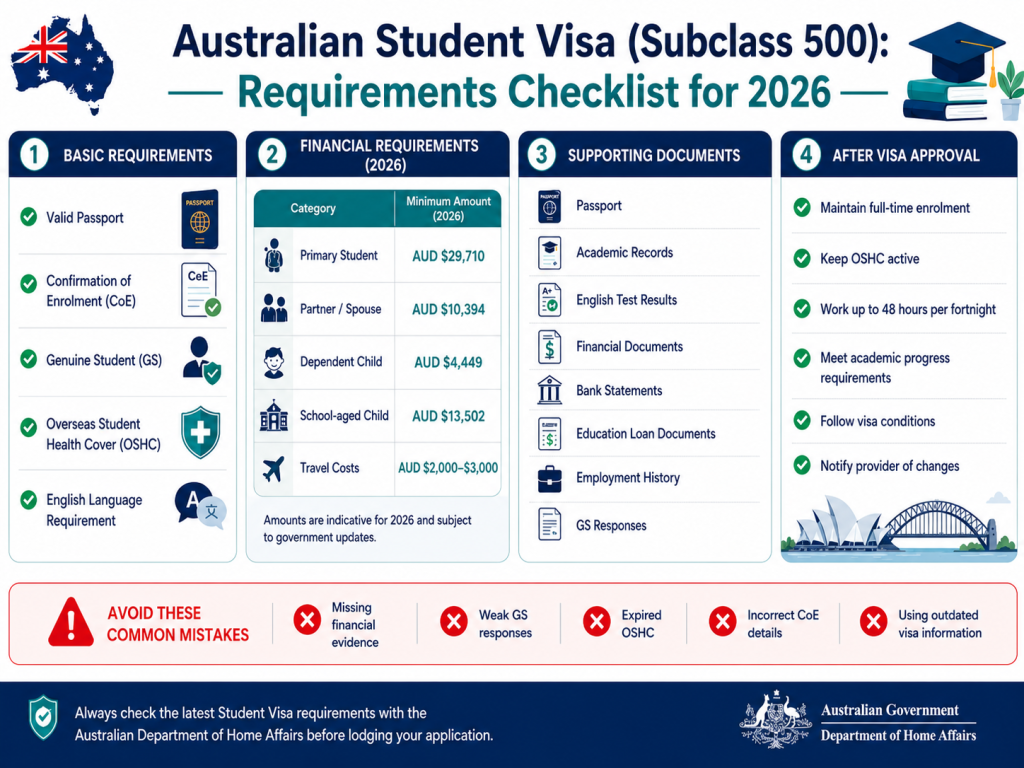
Here’s what you need to prepare.
Confirmation of Enrolment (CoE): Your Application Starts Here
A Confirmation of Enrolment (CoE) is an electronic document issued by an Australian education provider registered on the Commonwealth Register of Institutions and Courses for Overseas Students (CRICOS). It confirms you’ve accepted an offer, met the institution’s requirements and secured your place in a full-time course.
It’s also one of the first documents immigration officers look for.
If you’re applying from within Australia, a valid CoE must generally be attached when you lodge your Student Visa application. An offer letter alone is no longer enough.
This catches many applicants off guard. They assume they can submit their visa first and provide the CoE later, only to discover that their application may not even be considered valid.
Our tip: Before lodging, double-check that the details on your CoE, including your name, course dates and provider. Match the information in your passport and every other supporting document.
Overseas Student Health Cover (OSHC): More Than Just a Visa Requirement
Healthcare in Australia can be expensive, which is why Overseas Student Health Cover (OSHC) is compulsory for most Australian student visa holders.
Your policy should remain valid for the entire period you’re expected to stay in Australia, not just while classes are running. If your course is extended or your completion date changes, you’ll usually need to extend your OSHC as well.
When students ask us which provider they should choose, we always recommend looking beyond the premium. Compare the level of cover, waiting periods and inclusions to make sure the policy suits your circumstances.
Financial Capacity: It’s Not Just About Having the Money
This is one of the most misunderstood parts of the Student Visa process.
Many applicants believe that as long as they can show enough money in their bank account, they’ll satisfy the financial requirement. In reality, the Department also wants to know where those funds came from and whether you genuinely have access to them.
For 2026, the minimum financial benchmarks are:
Applicant | Minimum Funds Required (AUD) |
Primary Student | $29,710 |
Partner / Spouse | + $10,394 |
Each Dependent Child | + $4,449 |
Annual Schooling (per school-aged child) | + $13,502 |
Estimated Travel Costs | $2,000–$3,000 |
Source: Student Visa (Subclass 500) – Work Out How Much Money You Need
Remember, these figures cover living expenses only. You’ll also need to demonstrate access to funds for tuition fees and travel, where applicable.
Acceptable evidence may include:
- Personal savings with a clear financial history
- Government education loans
- Approved financial sponsorships
- Education loan sanction letters
- Other evidence accepted under current Department requirements
A New Challenge for Some Applicants: EL3 Financial Checks
If you’re applying from India, Nepal, Bangladesh or Bhutan, there’s another update you should know about.
Under the Evidence Level 3 (EL3) arrangements introduced in 2026, applications from these countries may be subject to enhanced financial scrutiny. This includes manually verified bank statements covering the previous three to six months.
Use the Department’s Document Checklist Tool with your specific passport and provider to check your evidence-level requirements before lodging.
Why does this matter?
Imagine depositing AUD $35,000 into your account just a week before applying without any supporting documentation. Even if the money is genuine, it may raise questions because there’s no clear paper trail.
That’s why we encourage students to start preparing their financial documents well before they intend to lodge their application. A consistent financial history is often far more convincing than a large last-minute balance.
The Genuine Student (GS) Requirement: Where Many Applications Succeed or Fail
If there’s one part of your Student Visa (Subclass 500) application that deserves extra attention, it’s the Genuine Student (GS) requirement.
Unlike financial documents or English test results, there’s no checklist you can simply tick off. This section asks you to explain your study plans in your own words, and that’s where many applicants struggle.
Some copy answers they find online. Others write only a few sentences because they think shorter is better.
Neither approach works.
At HDF Education Australia, we provide professional support for successful Student Visa 500 applications. We’ve reviewed countless student applications, and one pattern stands out. Strong GS responses aren’t filled with complicated language; they’re clear, specific and backed by evidence. Immigration officers want to understand your study journey, not read a template that’s been copied hundreds of times.
What Will You Be Asked?
Instead of submitting a separate GTE statement, you’ll answer four targeted questions directly in your ImmiAccount application. Each response is limited to 150 words, so every sentence needs to add value. (If you are applying onshore, or have previously held a student visa, you must answer an additional fifth question explaining your current visa situation and reasons for applying now.)
You’ll be asked about:
- Your current circumstances, including your family, employment and community ties.
- Why did you choose Australia, your education provider and your specific course?
- How does the course support your future career goals?
- Any other relevant information, such as study gaps, previous visa history or changes in your education pathway.
On the surface, these questions look straightforward. In reality, they’re designed to assess whether your application tells a logical and consistent story.
For example, imagine you’ve already completed a Bachelor’s degree in Business but now want to enrol in a lower-level diploma covering similar subjects. That’s not automatically a problem, but you’ll need to explain why this course makes sense for your career. Without a clear explanation, immigration officers may question your study intentions.
The same applies to study gaps, career changes or choosing Australia over other countries. Every decision should have a genuine reason behind it.
How to Apply for a Student Visa (Subclass 500)
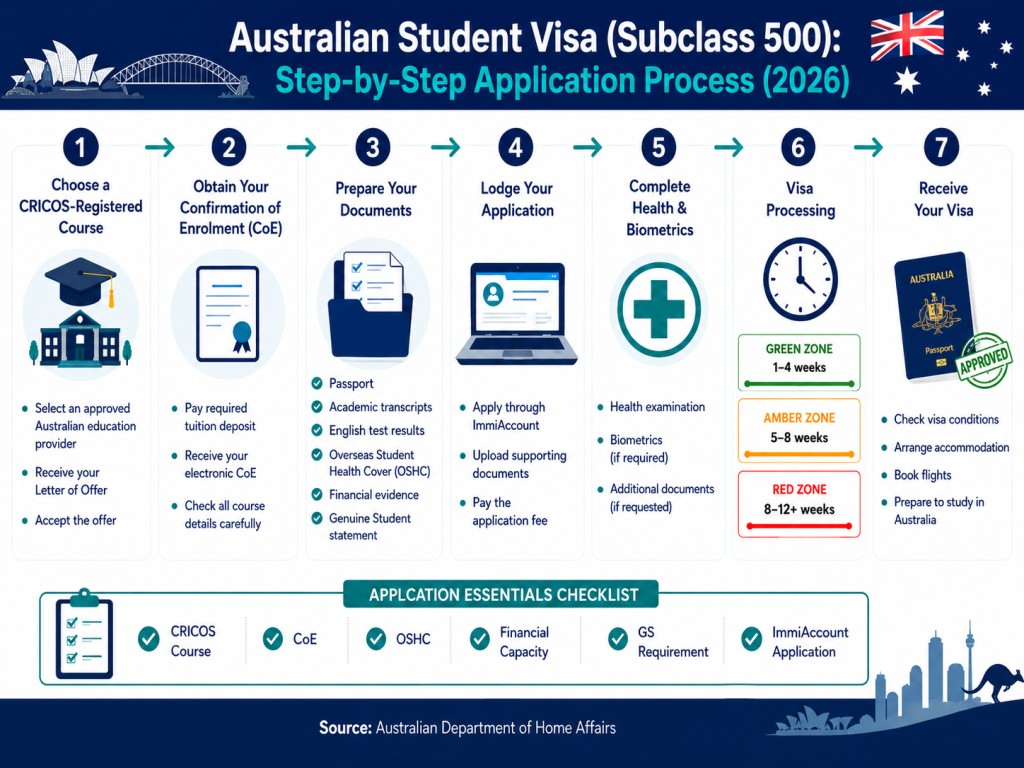
Once you’ve chosen your course and prepared your documents, the application process becomes much easier to manage.
Step 1: Choose a CRICOS-Registered Course
Apply to an approved Australian education provider. Once you’ve accepted the offer and met the institution’s requirements, you’ll receive your Confirmation of Enrolment (CoE).
Step 2: Organise Your Supporting Documents
Arrange your OSHC, academic transcripts, English language results, employment history and financial evidence, including sequential bank statements or approved education loan documents.
Step 3: Complete Your GS Responses
Take time to prepare thoughtful, evidence-backed answers rather than rushing through the online form. This is one section where quality matters far more than quantity.
Step 4: Lodge Through ImmiAccount
Submit your application online and pay the AUD $2,500 application fee, noting that card payment surcharges may also apply.
Step 5: Health Checks, Biometrics and Processing
Depending on your circumstances, you may be asked to complete health examinations with an approved panel physician and provide biometrics.
Since Ministerial Direction 115 (MD115) was introduced, offshore Student visa applications are prioritised according to an education provider’s progress against its indicative allocation under the National Planning Level (NPL), measured through New Overseas Student Commencements (NOSC).
As a general guide:
Processing Priority | Estimated Time |
Green Zone | Approximately 1–4 weeks |
Amber Zone | Approximately 5–8 weeks |
Red Zone | Approximately 9–12 weeks or longer |
In other words, two students submitting equally strong applications on the same day could receive decisions weeks apart if their institutions fall into different priority tiers.
After Approval: Don’t Overlook Your Visa Conditions
Receiving your visa isn’t the finish line; it’s the beginning of your responsibilities as an international student.
To keep your visa valid, you’ll need to:
- Maintain enrolment and satisfactory academic progress under Condition 8202.
- Work no more than 48 hours per fortnight while your course is in session. Remember, this is calculated over a rolling 14-day period, not by calendar week.
- Understand that Master’s by Research and PhD students generally have unlimited work rights once their course begins.
- Complete at least six months of your principal course before changing education providers in most cases.
- Stay enrolled at the same or a higher Australian Qualifications Framework (AQF) level unless you obtain the appropriate approval. Moving to a lower-level qualification may require a new Student Visa.
These conditions aren’t technicalities; they’re legal obligations. Even something as simple as incorrectly calculating your work hours can place your visa at risk.
Need Help with Your Student Visa (Subclass 500)? HDF Education Australia Can Help
Applying for an Australian Student Visa in 2026 is no longer just about collecting documents and completing an online form. With higher application fees, enhanced financial scrutiny, the Genuine Student assessment and stricter onshore rules, every part of your application needs to be carefully planned and supported.
If you’re still unsure about your student visa 500 requirements, course selection, financial documents, or Genuine Student (GS) responses, we’re here to help.
At HDF Education Australia, you’ll receive honest, one-on-one visa guidance with no hidden fees. So you can apply with confidence.